Introduction to Cloud ERP Hosting
In today’s fast-changing digital world, businesses are moving away from traditional systems. One of the biggest changes is the use of cloud ERP hosting.
But what does that mean?
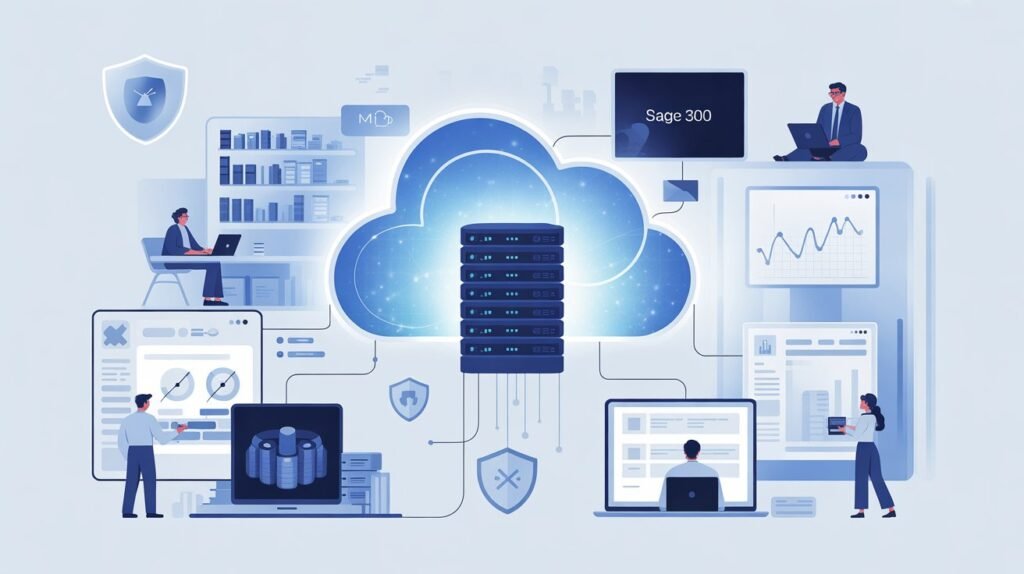
Simply put, cloud ERP hosting means running your Enterprise Resource Planning (ERP) software on remote servers instead of your local computer. You access it through the internet, just like using email or online apps.
This setup makes business operations easier, faster, and more flexible.
In this guide, we will explain everything in simple terms. We will also cover sage 300 erp cloud hosting, answer whether it is sage erp cloud or hosted, and explain what are the benefits of hosted cloud erp software.
What Is Cloud ERP Hosting?
Simple Explanation
Cloud ERP hosting is when your ERP software is stored and managed on a cloud server instead of your office computer.
You don’t need expensive hardware. You don’t need to install software manually.
You just log in and start working.
How It Works
Here’s how cloud erp hostings typically work:
- Your ERP system is installed on a secure cloud server
- A hosting provider manages the system
- You access it through a web browser or remote desktop
- Your data is stored safely in the cloud
This means your team can work from anywhere.
Types of Cloud ERP Hosting
1. Public Cloud Hosting
In this type, many businesses share the same server space.
- Lower cost
- Easy to scale
- Good for small businesses
2. Private Cloud Hosting
This is a dedicated environment for one business.
- More security
- Better control
- Higher cost
3. Hybrid Cloud Hosting
This combines both public and private clouds.
- Flexible setup
- Balanced cost and security
- Ideal for growing businesses
Sage 300 ERP Cloud Hosting Explained
What Is Sage 300 ERP?
Sage 300 ERP is a popular business management software. It helps companies manage:
- Accounting
- Inventory
- Payroll
- Operations
What Is Sage 300 ERP Cloud Hosting?
sage 300 erp cloud hosting means running Sage 300 on a cloud server instead of installing it on local machines.
This allows users to:
- Access data remotely
- Work from multiple locations
- Collaborate in real time
Is Sage ERP Cloud or Hosted?
Many people ask: is sage erp cloud or hosted?
The answer is:
- Sage ERP can be both cloud-based and hosted
- Some versions are built for the cloud (native cloud)
- Others are installed and then hosted on cloud servers
So, Sage gives businesses flexibility.
Key Features of Cloud ERP Hosting
1. Remote Access
You can log in from anywhere.
- Office
- Home
- Travel
This is one of the biggest advantages of cloud erp hosting.
2. Real-Time Data
All users see updated data instantly.
No delays. No confusion.
3. Automatic Updates
The hosting provider handles updates.
- No manual installation
- No downtime worries
4. Data Security
Cloud providers use strong security systems.
- Encryption
- Firewalls
- Backup systems
This makes hosted cloud erp software very secure.
5. Scalability
You can easily add or remove users.
Your system grows with your business.
What Are the Benefits of Hosted Cloud ERP Software?
1. Cost Savings
One of the biggest benefits is reduced cost.
- No need for expensive hardware
- Lower IT maintenance costs
- Pay-as-you-go pricing
This makes hosted cloud erp software budget-friendly.
2. Easy Setup
Setting up cloud erp hostings is simple.
- No complex installations
- Quick deployment
- Minimal downtime
3. Better Collaboration
Teams can work together easily.
- Share data in real time
- Access from different locations
- Improve communication
4. Improved Security
Many businesses worry about data safety.
But cloud erp hosting often offers better security than local systems.
- Regular backups
- Disaster recovery
- Advanced monitoring
5. Business Continuity
Even if your office shuts down, your system keeps running.
This ensures smooth operations.
6. Flexibility
Employees can work from anywhere.
This is especially useful for remote teams.
7. Automatic Backups
Data is backed up regularly.
You don’t have to worry about losing important information.
Cloud ERP Hosting vs On-Premise ERP
On-Premise ERP
This is the traditional setup.
- Installed on local servers
- Requires IT staff
- High upfront cost
Cloud ERP Hosting
Modern solution.
- Hosted online
- Lower upfront cost
- Easy access
Key Differences
| Feature | Cloud ERP Hosting | On-Premise ERP |
| Cost | Lower upfront | High upfront |
| Access | Anywhere | Office only |
| Maintenance | Provider handles | In-house IT |
| Scalability | Easy | Difficult |
Why Businesses Are Moving to Cloud ERP Hosting
1. Digital Transformation
Businesses want faster systems.
Cloud erp hosting helps them modernize operations.
2. Remote Work Trends
More people work from home now.
Cloud systems make this easy.
3. Competitive Advantage
Companies using hosted cloud erp software can:
- Make faster decisions
- Improve efficiency
- Stay ahead of competitors
Challenges of Cloud ERP Hosting
1. Internet Dependency
You need a stable internet connection.
Without it, access can be slow.
2. Data Migration
Moving data to the cloud can take time.
It must be done carefully.
3. Initial Learning Curve
Teams may need training.
But this is usually temporary.
Best Practices for Cloud ERP Hosting
1. Choose the Right Provider
Look for:
- Strong security
- Good support
- High uptime
2. Plan Data Migration Carefully
Ensure data is:
- Clean
- Accurate
- Well-organized
3. Train Your Team
Help employees understand the system.
This improves productivity.
4. Monitor Performance
Regularly check system performance.
Make improvements if needed.
Industries Using Cloud ERP Hosting
Many industries use cloud erp hostings, including:
1. Manufacturing
- Track inventory
- Manage production
2. Retail
- Monitor sales
- Manage stock
3. Healthcare
- Store patient data
- Manage billing
4. Finance
- Handle accounting
- Track expenses
Future of Cloud ERP Hosting
The future looks bright.
1. AI Integration
ERP systems will use AI to:
- Predict trends
- Automate tasks
2. Better Security
Security systems will keep improving.
3. More Automation
Routine tasks will become automatic.
This will save time and effort.
Conclusion
Cloud ERP hosting is changing how businesses operate.
It offers:
- Flexibility
- Cost savings
- Better collaboration
- Strong security
Solutions like sage 300 erp cloud hosting show how powerful this technology can be.
If you’re wondering is sage erp cloud or hosted, the answer is — it can be both, depending on your needs.
Most importantly, understanding what are the benefits of hosted cloud erp software helps businesses make smarter decisions.
As technology continues to grow, cloud erp hostings will become even more important.
Businesses that adopt them early will have a strong advantage.