In today’s digital world, businesses and individuals rely heavily on online services. Whether you run a website, an app, or store data online, you need a reliable system to host it.
Two common options are cloud hosting and traditional hosted solutions. Many people get confused between them. Terms like cloud vs web hosting, hosting cloud computing, and cloud-based hosting are often used, but not always clearly explained. Read About Cloud Hosting for Law Firms
This guide will break everything down in simple words. By the end, you will understand how both options work and which one is better for your needs.
What is Hosting?
Before we compare, let’s first understand what hosting means.
Hosting is a service that allows your website or application to be available on the internet. When someone visits your site, they are accessing files stored on a server.
A server is simply a powerful computer that stores and delivers your website data.
There are different types of hosting, including:
- Shared hosting
- Dedicated hosting
- VPS hosting
- Cloud-based hosting
Each type has its own features and benefits. Also You can Read About Hosted Cloud Desktop.
What is Traditional Hosted (Web Hosting)?
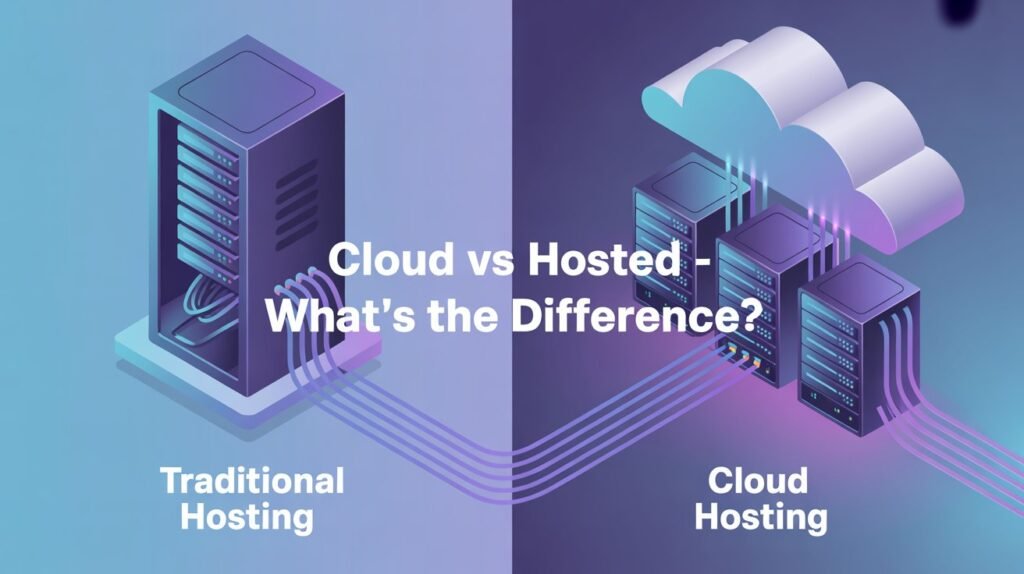
Traditional hosting, also known as web hosting, uses a single physical server or a group of fixed servers.
In this setup:
- Your website lives on one server
- Resources like storage and memory are limited
- You pay for a fixed amount of space
This is the most common type of hosting and is often used by small websites and beginners.
How Traditional Hosting Works
When you choose traditional hosting:
- Your hosting provider gives you space on a server
- Your files are stored on that server
- Visitors access your website through that server
If the server fails, your website may go offline.
Types of Traditional Hosting
Shared Hosting
Multiple websites share the same server. It is cheap but slower.
VPS Hosting
A server is divided into virtual parts. Each user gets dedicated resources.
Dedicated Hosting
You get an entire server for yourself. It is powerful but expensive.
What is Cloud Hosting?
Cloud hosting is a modern approach. Instead of using one server, it uses a network of servers connected together.
This network is called the “cloud.”
With cloud-based hosting, your data is stored across multiple servers, not just one. Read Cloud Storage on Remote Server.
How Cloud Hosting Works
In hosting cloud computing, your website:
- Uses multiple servers at once
- Pulls resources from a large network
- Can scale up or down easily
If one server fails, another takes over. This makes cloud hosting more reliable.
Cloud vs Hosted: The Core Difference
The main difference between cloud vs web hosting is how resources are used.
| Feature | Traditional Hosting | Cloud Hosting |
| Server Type | Single server | Multiple servers |
| Reliability | Lower | High |
| Scalability | Limited | Flexible |
| Cost | Fixed | Pay-as-you-use |
| Performance | Can slow down | Usually faster |
Key Benefits of Cloud Hosting
Cloud hosting has become popular for many reasons.
1. High Reliability
In cloud-based hosting, your data is stored in many places.
If one server crashes, another server takes over.
This reduces downtime and keeps your website running smoothly.
2. Easy Scalability
One of the biggest advantages of hosting cloud computing is scalability.
You can:
- Increase resources during traffic spikes
- Reduce resources when not needed
This flexibility is not possible with traditional hosting.
3. Better Performance
Cloud hosting distributes the load across multiple servers.
This means:
- Faster loading times
- Better user experience
It is ideal for websites with high traffic.
4. Pay-as-You-Go Pricing
Unlike fixed hosting plans, cloud-based hosting often uses a pay-as-you-use model.
You only pay for what you use.
This can save money in the long run.
Key Benefits of Traditional Hosting
Even though cloud hosting is advanced, traditional hosting still has its place.
1. Simple Setup
Traditional hosting is easy to understand.
Beginners can quickly set up their website without technical knowledge.
2. Lower Starting Cost
Shared hosting plans are very cheap.
This makes them ideal for small websites or personal blogs.
3. Predictable Pricing
With traditional hosting, you pay a fixed monthly or yearly fee.
There are no surprise charges.
Cloud vs Web Hosting: Performance Comparison
Performance is a major factor when choosing between cloud vs web hosting.
Traditional Hosting Performance
- Limited resources
- Slower during high traffic
- Can crash if overloaded
Cloud Hosting Performance
- Uses multiple servers
- Handles traffic spikes easily
- Faster loading speed
For growing websites, cloud-based hosting is usually the better choice.
Security Differences
Security is important for any online service.
Traditional Hosting Security
- Depends on a single server
- Vulnerable if the server is attacked
- Shared hosting can be risky
Cloud Hosting Security
- Data is distributed
- Advanced security features
- Backup systems in place
In hosting cloud computing, even if one server is compromised, your data remains safe.
Scalability: A Major Game Changer
Scalability is where cloud hosting truly shines.
Traditional Hosting
If your website grows:
- You need to upgrade your plan
- Migration can be difficult
Cloud Hosting
With cloud-based hosting:
- You can scale instantly
- No downtime during upgrades
This makes it perfect for businesses expecting growth.
Cost Comparison
Cost is always an important factor.
Traditional Hosting Costs
- Fixed monthly fee
- Cheaper at the start
- May require upgrades later
Cloud Hosting Costs
- Flexible pricing
- Pay for what you use
- Can be cost-effective for large projects
In the cloud vs hosted debate, cost depends on your usage.
Use Cases: When to Choose Each
Let’s look at when each option is best.
Choose Traditional Hosting If:
- You have a small website
- You are a beginner
- Your traffic is low
- You want a low-cost option
Choose Cloud Hosting If:
- Your website is growing
- You expect high traffic
- You need reliability
- You want flexibility
Cloud-Based Hosting for Businesses
Many businesses are moving to cloud-based hosting.
Why?
Because it offers:
- Better uptime
- Faster performance
- Easy scaling
E-commerce stores, apps, and large websites benefit the most.
Hosting Cloud Computing and the Future
The future of hosting is clearly moving toward the cloud.
With advancements in hosting cloud computing, we now have:
- AI-powered servers
- Automated scaling
- Global server networks
This means better performance and lower costs over time.
Common Misunderstandings
Many people misunderstand the difference between cloud vs web hosting.
Let’s clear a few myths.
Myth 1: Cloud Hosting is Always Expensive
Not true. It depends on usage.
Myth 2: Traditional Hosting is Outdated
It is still useful for small websites.
Myth 3: Cloud Hosting is Too Complex
Many providers offer simple interfaces.
Pros and Cons Summary
Cloud Hosting
Pros:
- High reliability
- Scalable
- Fast performance
Cons:
- Can be complex
- Costs may vary
Traditional Hosting
Pros:
- Easy to use
- Affordable
- Predictable pricing
Cons:
- Limited scalability
- Lower reliability
Conclusion
Choosing between cloud vs hosted solutions depends on your needs.
If you want simplicity and low cost, traditional hosting works well.
But if you need flexibility, performance, and growth, cloud-based hosting is the better option.
As technology continues to evolve, hosting cloud computing will likely become the standard for most businesses and websites.