With cloud computing services, modern businesses are changing the way they deal with technology. There is no need to invest in expensive hardware for any program, document, or business system since all these things can be available via the internet now.
Cloud computing solutions enable organizations to get access to such cloud services as storage, server, database, software, networking, security, and data processing services. This may help businesses save on IT costs, be flexible, and give employees an opportunity to work from anywhere. Google Cloud Services are Available Here!
No matter how big or small your company is, whether it is a global company or not, there are multiple uses for the cloud service for various organizations. Some businesses use cloud services for file storage, some execute full-fledged business applications and workloads in the cloud environment.
However, choosing the proper solution for you requires much attention and analysis. It is important to know your goals, security needs, budget, and more before making a choice.
What Are Cloud Computing Solutions?
Cloud computing solutions refer to technology solutions that provide computing capabilities via the Internet. Rather than buying all of the servers and software solutions needed, a business can acquire these from the cloud services provider.
Some of these include:
- Cloud storage
- Cloud servers
- Cloud databases
- Cloud networking
- Cloud security
- Cloud backup
- Cloud applications
- Data analytics
- Artificial intelligence solutions
- Disaster recovery
- Virtual machines
- Container platforms
A good example is where the business requires more computing resources due to increased demands. Rather than buying more servers that could go unused at a later time, a business can increase its computing resources from the clouds.
Flexibility is one of the main reasons why businesses consider cloud technology solutions.
Cloud computing solutions range from basic to advanced depending on the needs of the business. Small businesses can make use of email and file storage solutions while larger businesses can run their entire applications, databases, data analytics platform, and other internal systems from the cloud.
Reasons Why Companies Use Cloud Computing Solutions
Companies utilize cloud computing solutions for various reasons. Some companies are looking to cut infrastructure expenses, while others might require better performance, enhanced security, or easy accessibility to technology.
The key advantage of cloud computing solutions is flexibility.
Traditional IT infrastructure requires businesses to buy equipment before knowing their actual requirements. Cloud computing provides the opportunity to access resources depending on the needs of the business.
Infrastructure Costs Reduction
Developing an in-house data center can be costly. The companies might require to invest in servers, storage systems, networking equipment, cooling systems, back-up power supplies, and physical security measures.
Cloud computing can provide an alternative for such type of infrastructure.
Instead of buying and maintaining the equipment, businesses are required to pay for the services provided by the cloud service providers.
Such approach may contribute to a more flexible IT infrastructure development and reduce technology-related expenses.
It should be noted that cloud computing solutions do not necessarily provide cost savings in every case.
Ease in Business Scaling
The demands of business organizations are not static.
A web store might attract several thousand extra customers during the festive season. A finance organization might require extra processing power during certain reporting periods. An expanding software firm might need extra servers as it expands its customer base.
A cloud platform enables an organization to scale up or down depending on its requirements.
This is referred to as cloud scaling.
Scaling might be particularly useful for those organizations with uncertain demands.
Improved Remote Access
Many modern business organizations have employees who work from different offices or home-based offices.
A cloud computing solution allows authorized employees to access applications and data using the internet.
It facilitates remote working, collaboration among offices, and distributed teamwork.
Employees can use cloud applications, business applications, project management software, and other applications without having any direct connection to the internal server network of their organization.
Speedier Implementation
An IT project carried out using the traditional IT methods may take weeks or even months to procure, install, configure, and test the new hardware.
Implementation of cloud computing services is much easier and quicker.
For instance, a development team may develop a cloud infrastructure and start testing an application without installing any servers.
This will enhance agility in IT operations.
Types of Cloud Computing Solutions
Not all cloud-based solutions will suit every business.
Firms are allowed to select different kinds of cloud service models and cloud deployment strategies.
Knowing about these possibilities is necessary before implementing an enterprise cloud solution.
Infrastructure as a Service
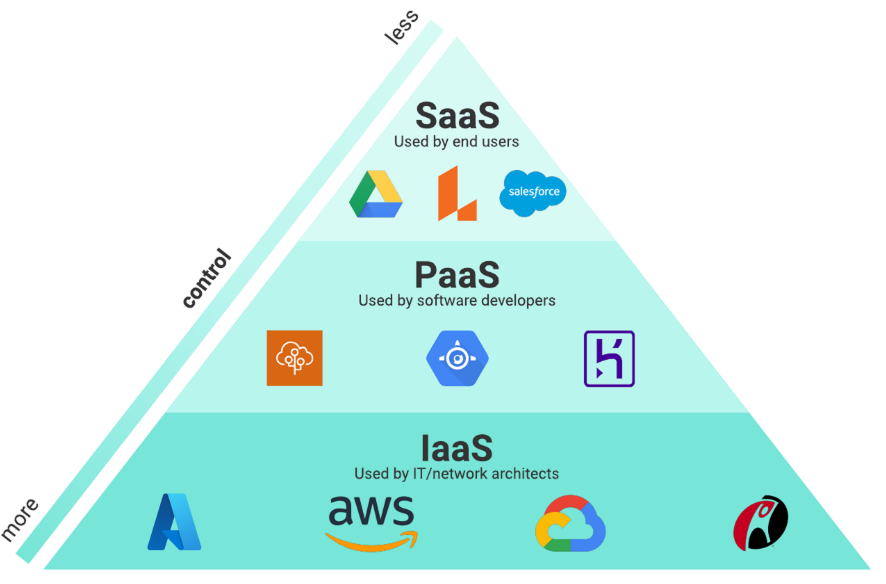
Infrastructure as a Service (IaaS) involves provision of basic computing infrastructure via the cloud.
This includes, but is not limited to, virtual servers, storage and networking.
Using Infrastructure as a Service allows firms to be more flexible in managing their computing resources, as they will be able to install operating systems and other software needed.
IaaS is widely used by:
- software development companies
- technology companies
- large enterprises
- application developers
- firms transferring physical servers to cloud
A firm may choose cloud-based virtual machines in lieu of buying physical servers for each application.
Platform as a Service
Platform as a Service (PaaS) is a service that provides a controlled environment for developers to build, test, and deploy applications.
Most of the infrastructure is managed by the cloud provider, which allows developers to concentrate on application development.
Examples of activities simplified by PaaS include:
- Application development
- Application testing
- Application deployment
- Database integration
- Application scaling
This service is valuable for businesses that wish to develop applications but do not need to manage all aspects of the underlying infrastructure.
Software as a Service
Software as a Service (SaaS) is a service that provides businesses with complete software applications via the internet.
These applications are accessed by users using a web browser or a separate application.
Examples of SaaS applications include productivity software, customer relations management software, accounting software, communication software, and project management software.
SaaS allows businesses to avoid installing software on each computer.
Cloud Storage Solutions
Data is one of the most valuable resources for businesses nowadays.
Cloud storage solutions allow businesses to store documents and other types of information in remote infrastructure provided by the cloud service providers.
The information that could be stored using cloud storage includes:
- Documents
- Business information
- Data from applications
- Media files
- Backups
- Archives
- Big data
Cloud storage may increase accessibility of the information for organizations.
Still, organizations should pay attention to the security of the data, access and encryption methods, data retention policy and regulatory compliance requirements prior to storing any sensitive information in the cloud.
Cloud Backup and Disaster Recovery
Information loss can have serious consequences for a business.
Hardware failures, unintentional deletion, cyber-attacks, software issues, natural catastrophes can render vital information inaccessible.
Using cloud backup services businesses can create copies of their critical data in remote infrastructure.
Also, businesses can leverage cloud-based disaster recovery solutions to recover applications and data in case of a major technical failure.
Disaster recovery solution should identify:
- What information needs protection
- Backup frequency
- Where backups are located
- Times for restoring systems
- Recovery responsibilities
- Test procedures
Public Cloud Computing
Public cloud is a type of cloud infrastructure that supplies computing resources using the cloud provider’s shared cloud infrastructure.
The firm uses the cloud provider’s services without purchasing any hardware for the underlying data center.
Features of the public cloud environment can include:
- High capacity flexibility
- Infrastructure worldwide
- Managed services
- Quick deployment
- Big technology ecosystem
Public clouds are used widely by startups, small and big companies, and different kinds of organizations.
Private Cloud
Private cloud is a cloud infrastructure that is intended to be used by a single organization.
It may offer increased control over infrastructure and configuration.
Private cloud infrastructures can be appropriate for organizations with certain security, compliance, performance, or operational needs.
However, private cloud infrastructures can require more management and capital investments compared to some public clouds.
Hybrid Cloud
The hybrid cloud is a combination of private infrastructure and public clouds.
For instance, an organization can host its critical systems on private infrastructure but utilize the resources of public clouds for application development or additional computing power.
This can provide organizations with more options.
However, it can complicate management since businesses have to secure the integration of multiple environments.
Multi-Cloud Solutions
There are some companies that use services offered by several cloud service providers.
This concept is referred to as multi-cloud computing.
The organization can pick different vendors based on their costs, locations, competencies, and other characteristics.
It can use different vendors to conduct data analytics and host its applications.
Multi-cloud solutions may offer certain benefits but at the same time complicate IT operations.
The companies may require special competencies in managing various platforms, security systems, accounting mechanisms, etc.
Cloud Solutions for Small Businesses
Small businesses usually do not have much money for IT department and specialists.
Cloud solutions will give small businesses access to professional technologies without a huge infrastructure team inside the company.
A small business can apply cloud technology for such needs as:
- Files storage
- Accounting
- Customer management
- Website hosting
- Virtual meeting
- Backup
- Security
Thus, a small company gets access to technologies that would require much money to develop an infrastructure.
Cloud Solutions for E-Commerce
Web companies should have good systems that can cope with different levels of traffic.
The cloud will help e-commerce firms with website hosting, database, payment apps, products’ info, analytics, and other workload.
In case of traffic peak, it will be possible to apply elastic cloud computing.
Cloud Solutions in the Field of Health Care
Health care organizations process large amounts of data.
There are solutions like cloud computing that can help to provide applications such as:
- Electronic Records
- Data Analytics
- Communication Systems
- Backup
- Administrative Applications
The health care organizations need to be very careful about data privacy, security, access control, and regulatory issues in the process of choosing cloud services.
The chosen solution should serve operational efficiency and effective protection of sensitive data.
Cloud Solutions in the Financial Industry
Financial organizations such as banks, insurance companies, investment firms, and others process large amounts of data.
Cloud computing can be used for the following purposes:
- Data analytics
- Customer applications
- Risk management
- Fraud detection
- Business intelligence
- Application development
- Backup and recovery
Future Trends of Cloud Computing Solutions
Cloud computing keeps evolving with businesses seeking better and more efficient solutions to their needs.
Innovative technological trends are shaping the way firms use cloud infrastructures.
Artificial intelligence, machine learning, edge computing, server less computing, and cloud computing analytics are becoming major components of modern tech strategies.
AI solutions could assist companies in analyzing huge data volumes, automating processes and creating intelligent apps.
Edge computing would help to analyze the data in close proximity to its origin which may be useful when quick reaction is needed.
Server less computing will enable developers to use application functions without having to control traditional servers directly.
All these innovations are expected to make cloud computing platforms more valuable to businesses from various industries.
Cloud Computing Solutions in Closing
Cloud computing solutions offer businesses flexible access to computing resources, storage capacity, applications, databases, security services, and other technology solutions.
Cloud computing solutions can serve organizations of any size.
Small companies could benefit from cloud solutions since they will have access to technology without the need for an extensive IT infrastructure. Larger companies will be able to leverage their enterprise cloud solutions for more advanced workloads.
Choosing cloud solutions should never be done based only on popularity or cost.
Security, scalability, performance, reliability, integration, support, compliance, and total cost of ownership should all be considered by businesses.
The best cloud technology solutions are the ones that solve the problem and are easy to manage. Read About Cloud Computing Services.